There are a lot of misconceptions. People think coaching is only about one-to
one, when you sit down with another person in front of you. In fact, that kind of
mentality is the reason why a lot of leaders are not able to fully dedicate their time
to coaching.
Imagine this, if you have a lot of operational tasks that you need to complete, at
the same time, your superior, your boss, comes to you with additional crisis or
firefighting situations that were not planned in the first place in your schedule. And
then suddenly you are required to do coaching.
Where do you find that time? Does that sound like you? Did you have an
environment where you felt that; “Coaching is something that I would do if I have the
luxury of time?”
Well, coaching does not have to be limited to a one-to-one sit down where you are
having a coaching conversation with a team member or a subordinate. This is the
good news! Coaching techniques can be used in many, many instances and
applications when you are running your operation.
Let me give you a specific example; You can use coaching questions when you're
running meetings. The moment you remove your role, your need and your ego to be
the person who needs to control the flow and decision-making in the meeting, you
can start coaching.
In the beginning of the meeting, you ask; “I have a set of agendas, but I would
like to hear what is on your mind. I would like to hear what is important for you to
achieve in this meeting.”
In this example, rather than the typical you telling the people attending your
meeting what are the agendas and what are the objectives, you activate the people in
the meeting to say what is important to them. The moment you do that, you are
exercising the coaching stance. At the same time, you do what you do and do
solutioning in the meeting.
If you want to conclude the meeting, using the coaching method, you ask; “I have
a list of things that I know we need to complete. I have a list of things that we have
agreed upon, but I would like you to summarise what is your main path or takeaway
for this meeting.”
Again, when you activate your team member to do the summarizing, they get to
tell you how they are digesting or benefiting from the meeting.
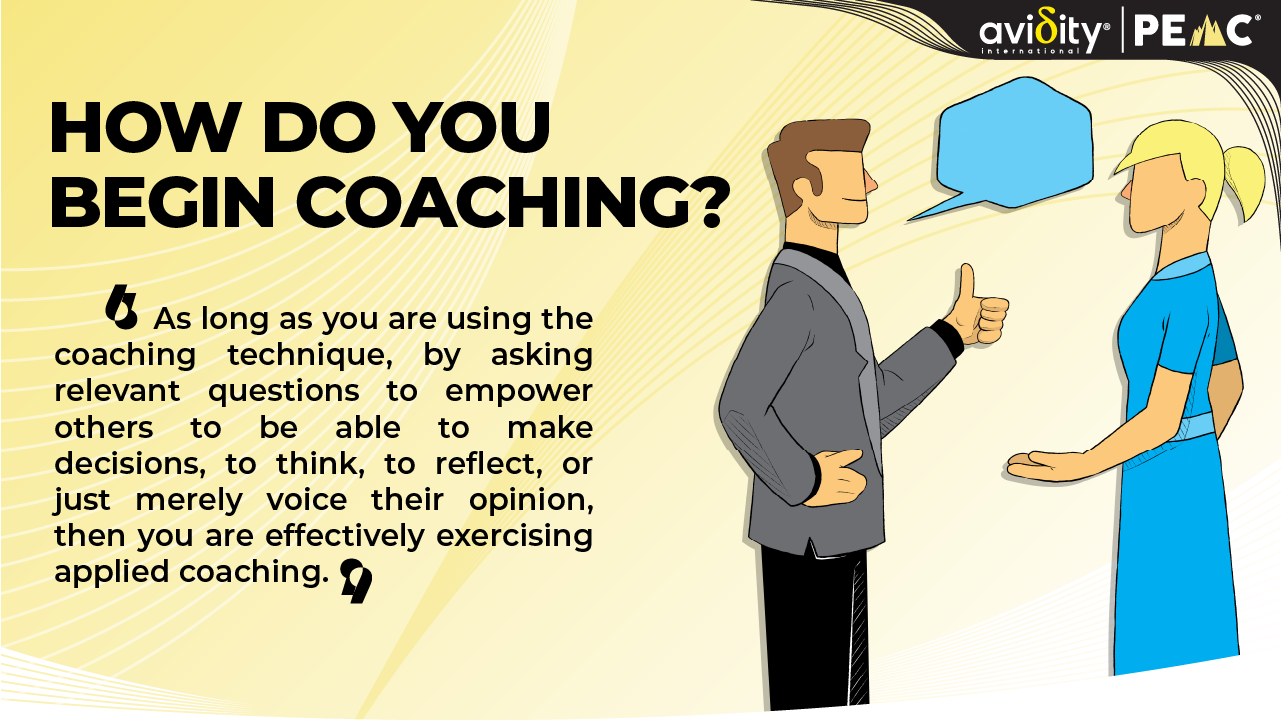
So, I want to inspire you to be able to look at coaching, not just from a sit down
one-to-one, but from another perspective, where as long as you are using the
coaching technique, by asking relevant questions to empower others to be able to
make decisions, to think, to reflect, or just merely voice their opinion, then you are
effectively exercising applied coaching. Coaching can be infused in your day-to-day,
and when you effectively do it, you will find the benefit of running operations more
effectively.
HAPPY COACHING!


It's a new technique I have gain on the coaching which I never thought before. It's very useful and will help me to apply this coaching technique in my day to day working environment as well during parenting period.
1. Applied coaching is not necessarily one to one session.
2. We can activate it by using right question to stimulate and empower them to think and reflect.
Coaching can be applied not only on one to one session but also during meeting or other occasion by asking relevant question.
Coaching is flexible technique. No fix time n place. it is not a formal session.
The article challenges the idea that coaching is a time-consuming, one-on-one requirement, advocating instead for integrating applied coaching techniques into daily operations. By using inquiry-based questions, particularly in group settings like meetings, leaders can foster individual engagement and achieve operational goals simultaneously.
Coaching is not limited to one-to-one sessions. It can also begin in meetings, where coaching techniques are used to draw out ideas, encourage open discussion, and support team brainstorming. By doing this, leaders help create an environment where team members feel valued and are encouraged to contribute actively.
Coaching doesn’t have to be formal one-to-one sessions; it can be applied in daily work and meetings by asking the right questions. When leaders shift from telling to engaging, they empower team members to think, share ideas, and take ownership, making operations more effective and collaborative.
Empowering team members to shares ideas can give benefits in day today operation.