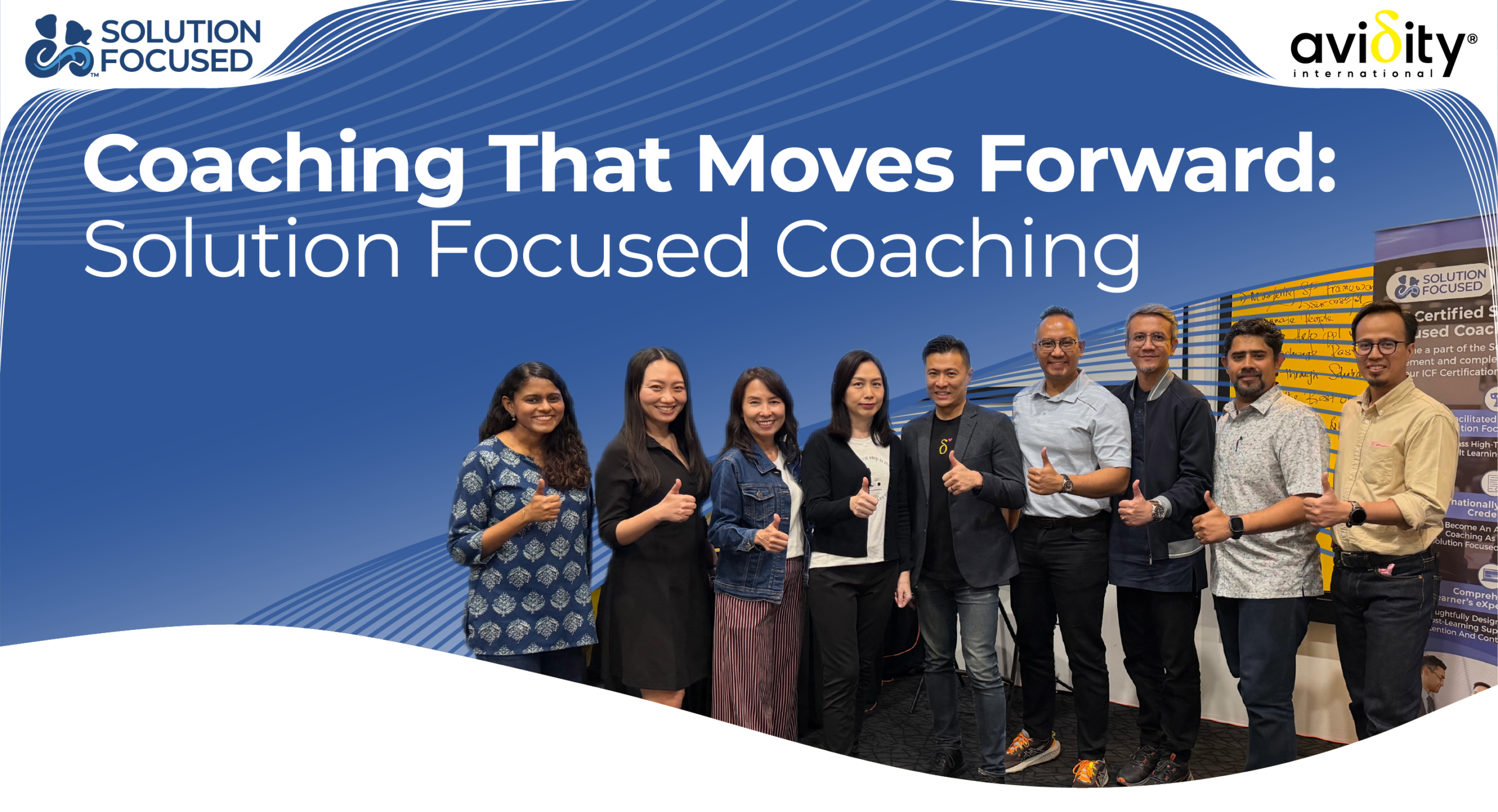
It’s easy to assume coaching is mainly about asking powerful questions. Solution focused coaching shifts the conversation even earlier than the question, and deeper than technique. It begins with an intention.
This lens changes how coaching can be understood: not as a search for the perfect question, but as a way of seeing the person in front of the coach as capable, resourceful, and already carrying seeds of movement.
People are not broken
- The coachee is not empty.
- The coachee is not helpless.
- The coachee is not waiting for the coach to become the hero.
They already have experiences, values, strengths, and moments of progress, even if those moments feel small right now. The coach’s job is to help make those moments visible and usable.
When this belief is held, the coach shows up differently: stepping away from a “diagnose and fix” mindset and no longer treating the problem as the most important part of the story.
Instead, the coach begins listening for possibilities.
What is solution focused coaching
Solution-focused coaching includes questions like:
- What do you want instead?
- What is already working?
- What strengths are already present?
- What small step is possible now?
But those questions only work when the coach is doing something deeper underneath them. Here’s what the approach is fundamentally about:

Building a preferred future, not unpacking a perfect past
Many conversations get stuck explaining the problem: why it happened, who caused it, and how long it has been going on.
Solution-focused coaching doesn’t ignore those realities. But it refuses to let the problem become the only destination of the conversation. There is no need to dwell on the problem in order to arrive at a solution.
Ask this instead: “If this were better, what would be different?”
Then stay with that image long enough for it to become clearer, more specific, and more actionable.
Paying attention to exceptions
Even in long-standing challenges, there are moments when the problem loosens its grip.
- A day when the coachee coped better than expected
- A moment when they responded more calmly
- A situation where they were slightly more confident, more present, or more direct
These “exceptions” aren’t random. They contain clues: What did the coachee do? What conditions helped? What strengths were present?
By exploring exceptions, the coachee starts to see that change is not theoretical. It has already happened in small pockets.
Scaling progress so change feels measurable
One of the simplest tools in solution-focused coaching is scaling:
- On a scale of 0–10, where are you now?
- What makes it a 4 and not a 2?
- What would a 5 look like?
- What small action would move you one point?
This matters because progress is often invisible when someone is overwhelmed. Scaling creates language for movement. It turns “I’m stuck” into “I’m at a 4, and here’s what’s helping me stay here.”
Making the “next step” small enough to actually happen
Solution-focused coaching is not a motivational talk. It is practical movement.
It respects the reality of human change: most progress is not a leap, but a sequence of manageable steps.
A solution-focused next step is not “transform your life.”
It’s more like:
- “What is one conversation you’ve been avoiding that you could prepare for this week?”
- “What is one boundary you can test gently?”
- “What is one habit you can start at a sustainable pace?”
Small steps compound. And they restore agency.
Solution focused coaching may be misunderstood
This approach can be misunderstood, so it helps to clarify what it is not. First, it is not positivity at all costs. It does not force optimism or bypass real pain. Likewise, it is not pretending the problem does not exist. Rather, it acknowledges reality while choosing not to live in it as the only frame.
In addition, it is not giving advice disguised as coaching. The coach does not hand over a solution, but helps the coachee generate their own. Finally, it is not a rigid script of questions, since the approach is a mindset and a direction, not a formula.
Presence is the invisible “method” behind this method
Watching solution focused coaching demonstrated in practice highlights something important.
The tools are not the magic. The presence is.
A coach needs discernment:
- when to ask
- when to pause
- when to reflect back what was said
- when to hold silence long enough for the coachee to hear themselves
Why this matters
In leadership, we are trained to solve, diagnose, fix, and respond quickly.
But solution-focused coaching offers a different kind of leadership muscle:
- Not just problem solving, but possibility building
- Not just direction giving, but capability growing
- Not just performance driving, but agency restoring

A simple starting point
If you’re new to solution focused coaching, here is a practical place to begin, whether you’re a coach, a leader, or someone supporting others:
- Ask: “What do you want instead?”
- Listen for what is already working.
- Identify one strength the person is already using.
- Define a small next step that feels doable.
- End by naming what progress would look like in the near term.
And underneath all of that, remember this,
The person in front of you is not broken. They are becoming.