
Most leaders step into leadership roles because they are capable problem solvers.
They have experience. They have expertise. They know how to navigate challenges and make decisions under pressure. Over time, people naturally begin turning to them for answers, guidance, and solutions. In many organizations, this becomes the expectation. When a problem arises, the leader is expected to know what to do.

At first, this may seem like a sign of effective leadership. After all, leaders are supposed to help their teams succeed. However, many leaders eventually find themselves carrying an unexpected burden. They become the person everyone depends on for answers, approvals, and decisions. Team members constantly seek direction. Progress slows whenever the leader is unavailable. Problems continue to flow upward rather than being resolved where they occur.
The challenge is not that leaders are helping too little.
The challenge is that they may be helping too much.
When Good Intentions Create Dependency
Most leaders do not intentionally create dependent teams. In fact, they often step in because they genuinely want to support their people. When a team member faces a challenge, providing a solution feels efficient. It resolves the issue quickly and allows work to continue moving forward.
The problem is that every answer a leader provides can unintentionally remove an opportunity for someone else to think, learn, and grow.
Imagine a team member approaching a manager with a challenge. Before the employee has time to explore options, the manager immediately offers advice and outlines the next steps. The issue may be resolved in the moment, but an important opportunity has been missed. The employee leaves with a solution, but not necessarily with greater capability.
The Hidden Cost of Always Having the Answer
Leaders often assume that providing answers creates efficiency. In the short term, it often does.
In the long term, however, the costs can be significant.
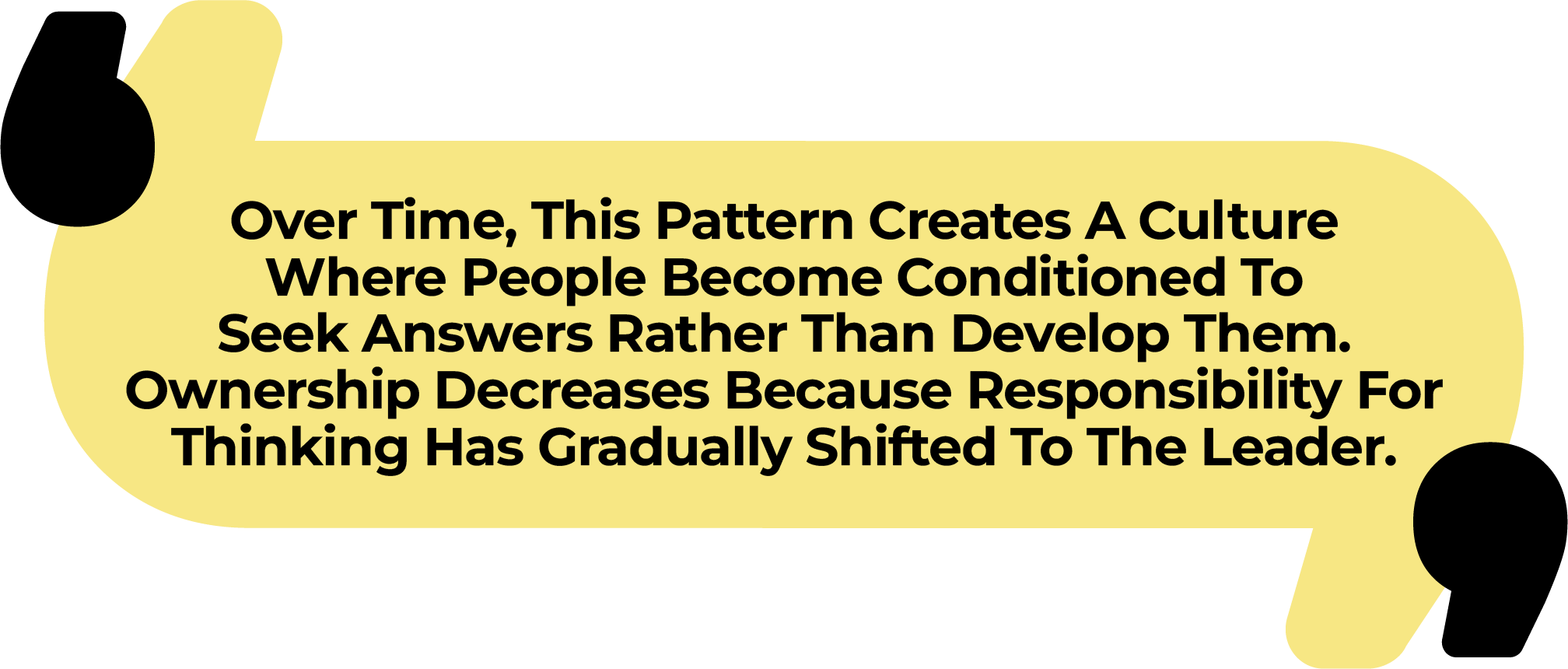
When people rely heavily on leaders for direction, decision making becomes slower. Innovation decreases because individuals become hesitant to contribute ideas. Confidence weakens because people stop trusting their own judgment. Leaders become overwhelmed because every challenge eventually finds its way to their desk.
The organization becomes dependent on a small number of people rather than developing capability throughout the team.
Ironically, the more leaders solve problems for others, the more problems they are likely to inherit.
A Different Leadership Approach
Applied Coaching offers a different perspective.
Rather than seeing leadership as providing answers, Applied Coaching views leadership as developing people. The goal is not simply to solve today’s problem. The goal is to help people become more capable of solving future problems on their own.
This shift changes the role of the leader significantly. Instead of immediately offering solutions, leaders become curious. They ask questions that encourage reflection, awareness, and ownership. They create space for people to think through challenges and explore possibilities before receiving guidance.
The conversation moves from “Here is what you should do” to “What do you think would work?”
While this approach may take slightly longer in the moment, it often creates stronger and more sustainable outcomes over time.
How Coaching Develops Ownership
One of the most powerful outcomes of coaching is ownership.
When people are given opportunities to think through challenges, evaluate options, and make decisions, they begin to develop confidence in their own abilities. They become more invested in the outcomes because they played an active role in creating the solution.
Consider the difference between these two leadership responses.
A manager says:
“Here is what you need to do.”
A coaching leader asks:
“What have you considered so far?”
Both leaders want the problem solved. However, one approach develops compliance while the other develops capability.
Coaching does not mean leaders never provide advice. There are situations where expertise, direction, and instruction are necessary. The difference is that coaching leaders do not begin there. They first explore what people already know, what they have already considered, and what solutions they are capable of generating themselves.
This simple shift can have a profound impact on ownership, accountability, and growth.
Developing Thinkers, Not Followers
The strongest teams are not built around leaders who have all the answers.

They are built around people who have learned how to think, solve problems, and take responsibility.
Applied Coaching recognizes that sustainable leadership is not measured by how many problems a leader can solve. It is measured by how many people become capable because of that leader.
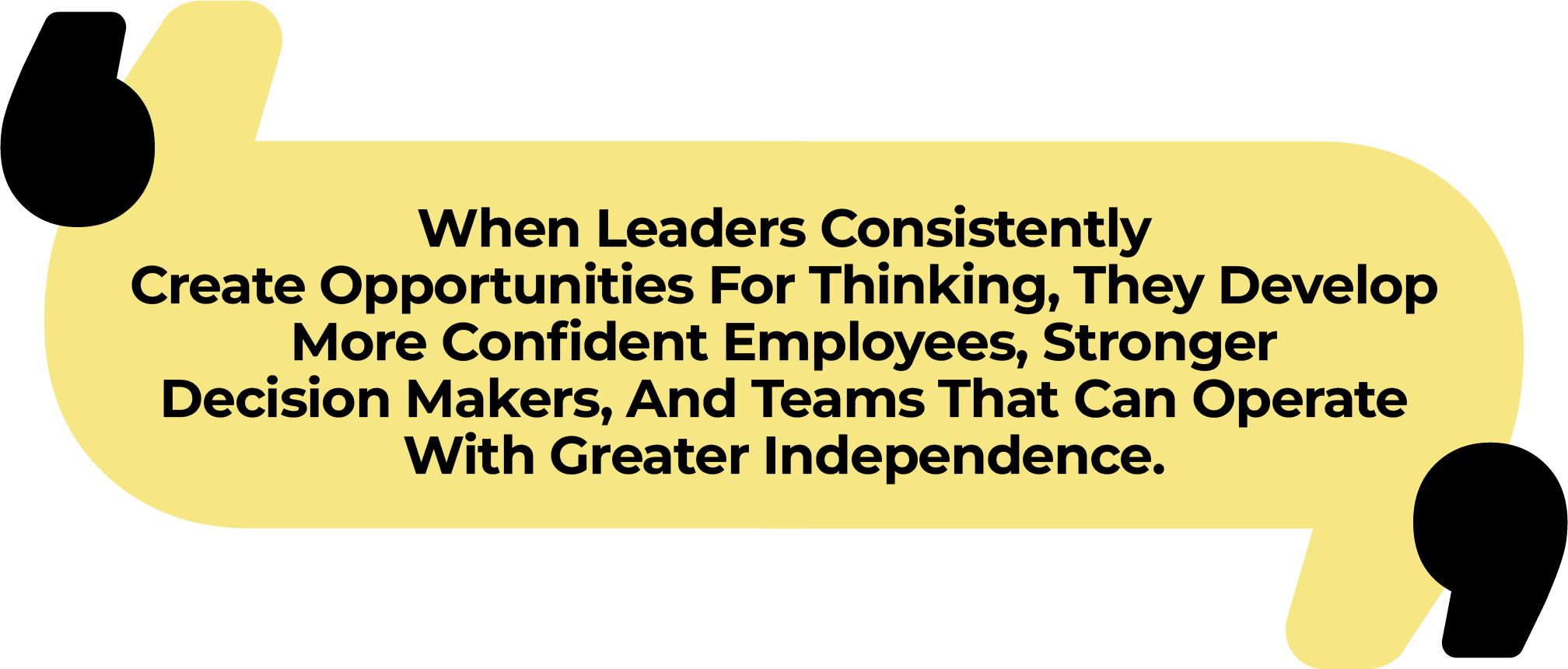
The result is not only better performance. It is greater leadership capacity throughout the organization.
Reflection for Leaders
Every time a team member comes with a challenge, leaders have a choice.
They can provide an answer, or they can create an opportunity for growth.
Neither approach is inherently right or wrong. The key is recognizing the long term impact of each decision.
As you reflect on your leadership, consider these questions. How often do people come to you for answers? Where might you be unintentionally creating dependency? And what might change if you spent less time solving problems and more time developing thinkers?
Pause & Notice: A Leader’s Coaching Awareness Check
Rating guide: 5 = Highest (most true for you) 1 = Lowest (least true for you)
☐ I tend to give solutions immediately because time feels urgent.
☐ I coach only when I have the luxury of time.
☐ I believe not everyone can benefit from coaching.
☐ I believe coaching is essential, but operational needs usually come first.
☐ I feel I need a thorough root-cause analysis before I can coach.
The best leaders are not remembered because they had all the answers.
They are remembered because they helped others discover their own.